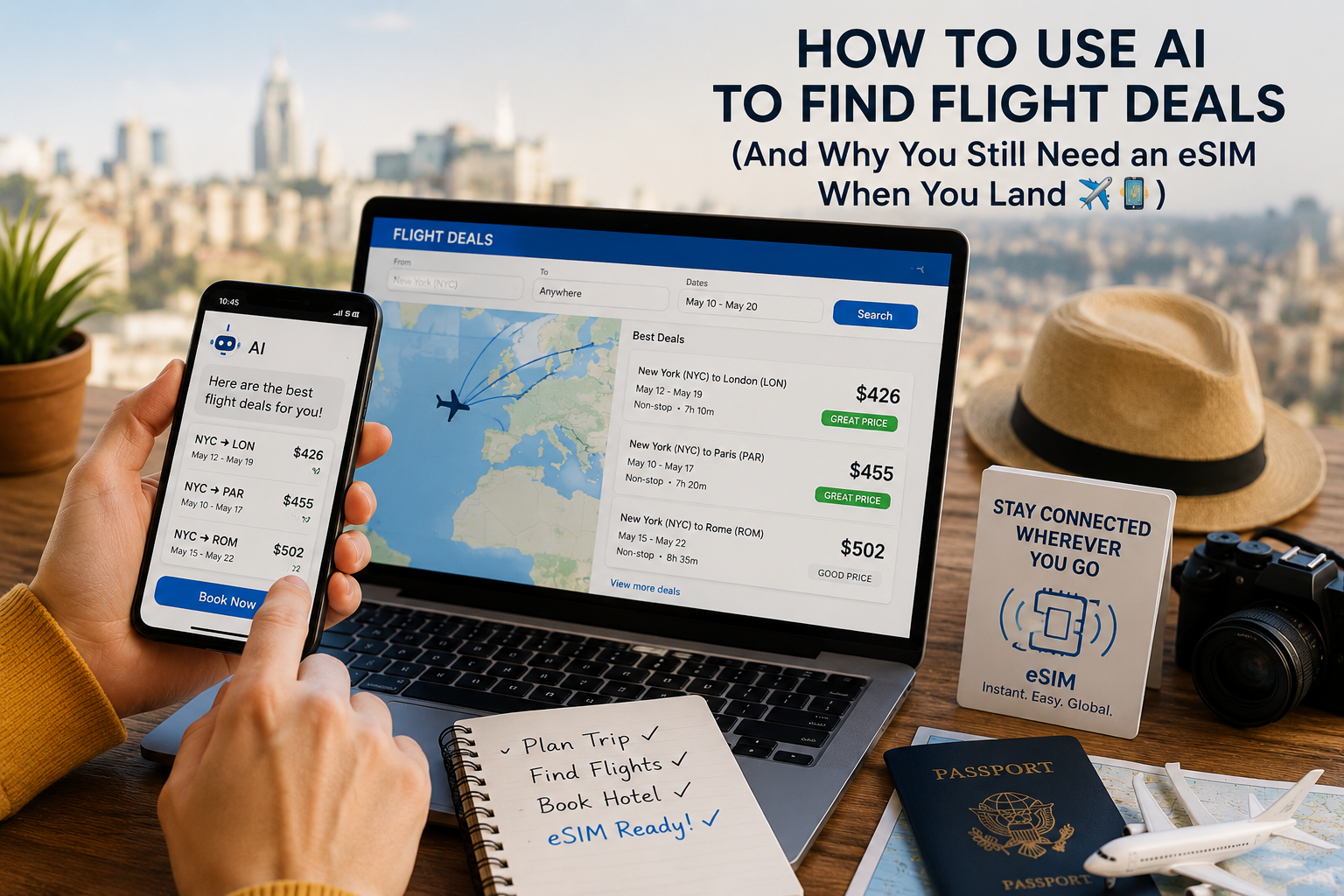
How to Use AI to Find Flight Deals (And Why You Still Need an eSIM When You Land)
Booking a flight used to mean fifteen browser tabs open at once, refreshing Google Flights every hour, and hoping you clicked buy at the right moment. That whole process has quietly changed. AI-powered tools now scan millions of fare combinations, predict whether a price will rise or fall, and surface routes a human would never find manually. If you have not updated how you search for flights in the past year, you are almost certainly overpaying.
Why Flight Search Suddenly Got Smarter
Traditional flight search engines show you what is available right now, at this exact moment, on this exact route. AI flight tools go further. They evaluate historical pricing patterns going back years, factor in things like competitor schedule changes and even broader booking trends in nearby regions, and generate a confidence score on whether you should buy today or wait. This shift from reactive searching to proactive prediction is the single biggest change in how smart travelers book flights right now.
Start With Plain-English Search Tools
The easiest entry point is a tool that lets you describe your trip the way you would to a friend, rather than filling out a rigid form with fixed dates and airports. Type something like flights from Lisbon to Bangkok sometime in October, under 600 euros, and let the tool interpret it. These natural-language flight finders have become the standard starting point because they surface options you would not think to search for manually, including date ranges and nearby airports you had not considered.
Cross-Check Price Predictions Before You Book
Once you have a shortlist of routes, run them through a price-prediction tool. These models look at how a specific route has historically moved in price and give you a straightforward buy now or wait signal, often with a stated accuracy rate. This step alone can save you from the classic mistake of booking too early out of anxiety, only to watch the price drop two weeks later.
Let AI Handle Mistake Fares and Flash Sales
A separate category of tool exists purely to catch pricing errors and short-lived flash sales, the kind of deal that appears for a few hours and vanishes. Setting an alert by your home airport means you get notified the moment one of these fares appears, rather than stumbling onto it by chance on social media after it is already gone.
Use Conversational AI for Route Research
General-purpose AI assistants are also genuinely useful here, not just for booking but for the research layer around it. Ask one to compare the true cost of two routes factoring in baggage fees, layover length, and typical delay rates for a specific route, and you will get a far more complete picture than a bare ticket price ever gives you. This is especially useful for multi-city or repositioning trips where the cheapest individual flights do not always add up to the cheapest overall itinerary.
The Part AI Cannot Book For You
Here is the piece that is easy to forget once you have locked in a great fare: none of these tools do anything about what happens after you land. You can save two hundred dollars on a flight to Bangkok and then lose half a day of your trip standing in an airport SIM card line, or come home to a roaming bill that erases the savings entirely.
This is where planning connectivity ahead of time actually matters. The same way you would not leave flight booking until the last minute anymore, it is worth applying that same forward planning to how you get online the moment you land. An eSIM set up before departure means you walk out of arrivals already connected, already able to pull up a map or confirm your ride, without hunting for a kiosk or a local SIM shop.
Building the Full Workflow
The smartest way to plan a trip in 2026 looks less like a single tool and more like a short sequence. Use an AI flight finder to lock in the best fare. Set a mistake-fare alert for your home airport in case something even better appears before departure. Use a conversational AI tool to sanity-check the total cost of your route, not just the sticker price. And before you fly, spend two minutes setting up your eSIM so connectivity is one less thing to think about the moment you touch down.
AI has made the booking half of travel dramatically smarter. The other half, staying connected once you actually arrive, still comes down to planning ahead. Getting both right is what separates a smooth trip from one spent troubleshooting in an airport terminal.
Precisa de dados para a sua viagem?
Explore planos eSIM para mais de 190 destinos — entrega instantânea por QR code.
Explorar destinos